Understanding gender diversity in our meetings
How can Quaker meetings welcome and support people who are trans or gender nonconforming? Rhiannon Grant reflects on a recent paper which can help.
As part of our wider commitment to being welcoming and inclusive, Quakers in Britain welcome and affirm trans, nonbinary, and gender nonconforming people in our communities. In a world where trans people are often excluded or even attacked, finding a faith community which is understanding and supportive can be hugely important. It's great that we already have many nonbinary and trans Friends in our communities, but how can those of us who are not trans ensure that we offer consistent support?
In order to help all Quakers understand gender diversity and deepen our love for one another, our national representative body Meeting for Sufferings recently endorsed a paper from the Quaker Committee on Christian and Interfaith Relations (QCCIR) which explores the theology underlying Britain Yearly Meeting's 2021 minute on the topic.
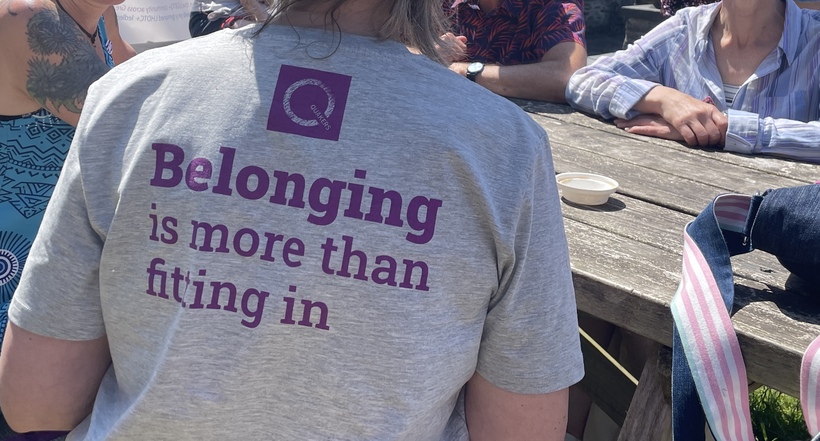
That minute said, in part, "We seek to provide places of worship and community that are welcoming and supportive to trans and nonbinary people who want to be among us. Belonging is more than fitting in. With glad hearts we acknowledge and affirm the trans and gender diverse Friends in our Quaker communities, and express appreciation for the contribution and gifts that they bring to our meetings, which are communities made up of people with a diverse range of gender expressions."
Theological foundations
The minute reflects the discerned position of Yearly Meeting, but making it a reality needs ongoing and prayerful work. A small number of Friends have found it hard to understand or accept. Acknowledging the reality of this, QCCIR's paper reminds us of the importance of loving one another.
It also discusses some of the ways in which the hard gender boundaries constructed by society are deconstructed in the Divine: in Christ there is no male and female, as Paul said in Galatians 3:18, and Margaret Fell said, in her argument for the legitimacy of women as ministers of God's word, that God "makes no such distinctions and differences [between genders] as men do; for though they be weak, he is strong".
Following this line of thinking, the paper reminds us that as Quakers, we "are guided to perceive humanity as created both male and female in the image of a God who is beyond gender. Indeed, the very form and essence of Quaker worship that is rooted in silent waiting embodies a radical equality of all humans before God".
Drawing on the language of the Psalms, the paper describes us as each made "most intricately and wonderfully". Gender diversity, as with other kinds of diversity, is "part of the richness of the unconditional love the Inner Light offers and by which we seek to be guided". There may be people in any community we find difficult to understand, especially if their experience and ways of expressing themselves are outside the norms for a particular culture, generation, or gender. That doesn't allow us to reject them or require them to explain themselves, especially if this becomes repetitive or combative.
What can we do?
The paper finishes with a list of queries which we could ask ourselves and our meetings. It asks, for example, whether we invite the sharing of pronouns and gender self-identification amongst our worshippers. One small step would be to share your own – whether or not you are trans or gender nonconforming, if you feel comfortable adding your pronouns to your Zoom screen name, name badge, or introduction at the end of worship, this sends a clear signal that you are ready to hear and respect other people's pronouns and experiences with the complexities of gender.
Attending to trans voices and listening deeply to the experience of trans people is vital in this work. It can be good to share our experiences in community, but it can also difficult. It's important not to assume someone wants to speak about gender just because they are nonbinary, gender nonconforming, or have transitioned. They may not feel safe, not want to be known for their gender alone, or be tired of retelling the story. Or they might be delighted to help and feel seen and appreciated! Ask and be ready to accept the answer. An alternative is to use online resources or a book to hear from someone who has chosen to share – see the links below.
Other activities build the whole community, without specific attention to gender. Being ready to have hard conversations and address conflict when it arises, including challenging hurtful words or actions, will help our communities to name and repair the damage. Checking whether people who are newer to the community are beginning to feel like they belong may show up many ways in which we accidentally exclude. And a chat over coffee or shared lunch, starting with the ordinary but willing to go deep, can be powerful on any topic.