New Economy booklets and session plans
Produced between 2016 and 2017 the New Economy series is a collection of booklets and session plans for individual exploration or for facilitators to host and run group discussions about economics. They do not need any expertise whatsoever on economics. Please let us know if you have any feedback.
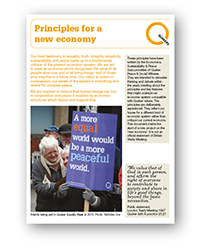
Principles for a new economy
Our lived testimony to equality, truth, integrity, simplicity, sustainability and peace leads us to a fundamental critique of the present economic system. We are led to seek an economy which recognises the value of all people alive now and of all living things, and of those who may live in a future time. Our vision is rooted in compassion, our sense of the sacred in everything and desire for universal peace.
This resource grounds the rest of the New Economy series and suggests ten principles for an economic system that is compatible with Quaker values.
Download
Principles for a new economy (PDF).
Order hard copies through the order form.
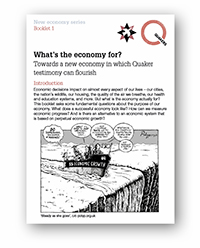
Booklet 1: What is the economy for?
Economic decisions impact on almost every aspect of our lives – our cities, the nation's wildlife, our housing, the quality of the air we breathe, our health and education systems, and more. But what is the economy actually for? This booklet asks some fundamental questions about the purpose of our economy. What does a successful economy look like? How can we measure economic progress? And is there an alternative to an economic system that is based on perpetual economic growth?
Download
Booklet 1: What is the economy for? (PDF)
and
Session plan: What is the economy for? (Word).
Order hard copies through the order form.
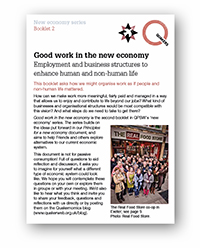
Booklet 2: Good work in the new economy
How can we make work more meaningful, fairly paid and managed in a way that allows us to enjoy and contribute to life beyond our jobs? What kind of businesses and organisational structures would be most compatible with this vision? And what steps do we need to take to get there? This booklet examines employment and business structures to enhance human and non-human life.
Download
Booklet 2: Good work in the new economy (PDF)
and
Session plan: Good work in the new economy (Word).
Order hard copies through the order form.
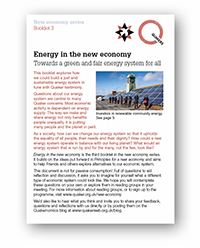
Booklet 3: Energy in the new economy
This booklet explores how we could build a just and sustainable energy system in tune with Quaker testimony. Questions about our energy system are central to many Quaker concerns. Most economic activity is dependent on energy supply. The way we make and share energy not only benefits people unequally, it is putting many people and the planet in peril. As a society, how can we change our energy system so that it upholds the equality of all people, their needs and their dignity? How could a new energy system operate in balance with our living planet? What would an energy system that is run by and for the many, not the few, look like?
Download
Booklet 3: Energy in the new economy (PDF)
and
Session plan: Energy in the new economy (Word).
Order hard copies through the order form.
Booklet 4: Money, banks and finance in the new economy
This booklet, the fourth in QPSW's new economy series, is not for passive consumption! Full of questions to aid reflection and discussion, it asks you to imagine for yourself what a different type of economic system could look like. How could the banking system and money creation be fairer? We hope you will contemplate these questions on your own or explore them in reading groups in your meeting.
Download
Booklet 4: Money, banks and finance in the new economy (PDF)
and
Session plan: Booklet 4: Money, banks and finance in the new economy (Word).
Order hard copies through the order form.
Booklet 5: The role of markets in the new economy
What are markets and when do they work best for us? Many in public life believe and argue that the distribution of goods and services is done most efficiently through free markets. Why do they say this? And is it an adequate argument for applying market processes in public services such as the NHS? This booklet explores these questions. It looks at the alternatives to markets and for-profit provision and suggests how market and non-market provision might be organised in the new economy.
Download
Booklet 5: The role of markets in the new economy (PDF)
and
Session plan: The role of markets in the new economy (Word).
Order hard copies through the order form.
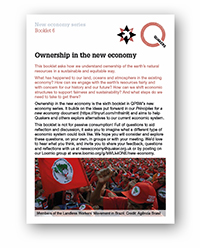
Booklet 6: Ownership in the new economy
This booklet asks how we understand ownership of the earth's natural resources in a sustainable and equitable way. What has happened to our land, oceans and atmosphere in the existing economy? How can we engage with the earth's resources fairly and with concern for our history and our future? How can we shift economic structures to support fairness and sustainability? And what steps do we need to take to get there?
Download
Booklet 6: Ownership in the new economy (PDF)
and
Session plan: Ownership in the new economy (Word).
Order hard copies through the order form.
Booklet 7: Building the new economy
The final instalment of the series sets out the resources, actions and ideas that are fundamental to our future economic wellbeing. It asks how we bring about a just transition to a new economy. Who built today's economic system? What principles make up this system and what impact does this have on our society and the environment? How do we build an economy based on Quaker principles? Why do we need a just transition? Who do we need to work with to get there?
Download
Booklet 7: Building the new economy (PDF)
and
Session plan: Building the new economy (Word).
Order hard copies through the order form.
Meeting for discernment session plan
To close the series and provide space for reflection, we have designed a session that will support discernment on building the new economy.
Download
Meeting for discernment session plan (Word .doc)