Powerful and not for everyone: The Testament of Ann Lee
Rhiannon Grant reviews this recent film, a biography of a woman who received a spiritual leading to found a new community – the Shakers.
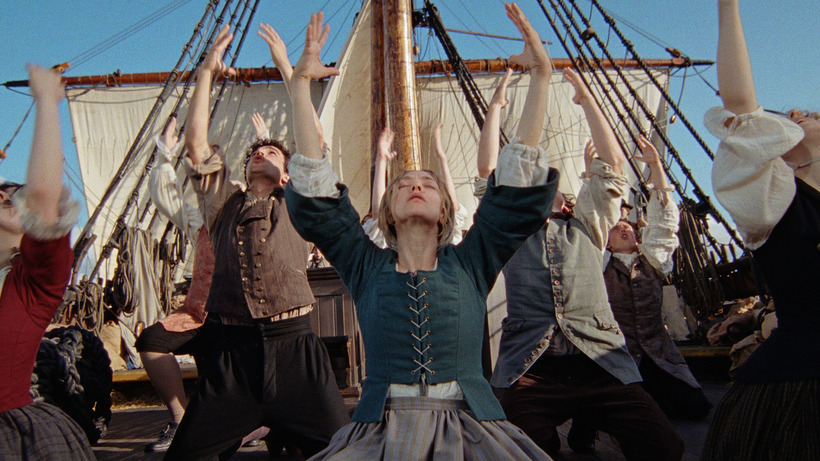
The Testament of Ann Lee (2025, dir. Mona Fastvold) is a biography of a woman who received a spiritual leading to found a new community. It takes us from her childhood in the mills of Manchester to her death as the leader of the Shaker movement in America.
Like Quakers, Shakers are a branch of Protestant Christianity with a strong emphasis on God speaking directly to individual believers. The revelations people receive in the film are often comparable to those received by Quakers, both historically and today.
It's a profound and, at times, disturbing film, with a deep sense of the beauty and pain of life. But although the film's narration sometimes stands back from potential miracles, it takes spiritual experiences to be real within the plot in ways which reminded me of how Quakers speak about our leadings and concerns. It includes positive depictions of topics rarely covered in mainstream films: spiritual ecstasy, people being led by the Spirit, and the attractions of a faith community.
Ann Lee (1736-1784, played by Amanda Seyfried) had a difficult life and the film embraces this. The story features physical and sexual assault, several deaths, and religious persecution. As part of setting the scene, it includes children working in unhealthy factory conditions, enslaved people being openly trafficked (to which Ann Lee and her group cry out 'Shame!'), Native Americans who are being colonised as well as befriending the new arrivals, and the outbreak of war.
Women's leadership
Ann Lee is clearly shown to be a leader, sometimes the leader, of her Shaker community. At some points she is treated as the second coming of Christ. Less direct is the Quaker connection: the narration tells us briefly that the Shakers we meet early in the film are a breakaway group, known as Shaking Quakers for their more physical worship style. The spiritual equality of women and men is another aspect of this inheritance.
For some characters in the story, Ann's abilities are incompatible with her gender, and they struggle to accept her religious role or challenge her femininity. One of several deeply disturbing scenes shows her skirts being ripped away to examine her genitals. Overall, however, the film is on Ann's side. She is a successful spiritual leader, the people who follow her love her dearly, she wins over sceptics by her God-given insight and willingness to work hard as well as pray hard, and her community flourishes. Fans of Quaker women like Margaret Fell are likely to agree with this too.
Not for everyone
The Shaker community is not for everyone. As leader, Ann Lee has some strict principles and will not be moved, especially once she has established her rule of celibacy. She does not condemn sexual activity within marriage, but people who form those relationships have to leave her group, even when that means being reduced to a very small number. (This principle has been maintained; at the end of the film we're told by an information card that the Shaker population at the time it was made was two people.)
The film will also not be for everyone. The content can be disturbing. Although this was sometimes gory or explicit, it was a genuine part of the story, with tragic events (such as Ann's four labours and the deaths of her babies) shown rather than merely being told at a remove. Although hard to watch, this gave a feeling of truth-telling to the film's structure which resonates with Quaker approaches.
The film is described as a musical, but this is not a world of showtunes. It uses some traditional Shaker melodies and explores the power of sound and the human voice to express anguish, fear, and guilt. My wife found the soundtrack, especially the episodes of screaming, deeply unpleasant, more so than the images. As well as music, the worship involves crying out and groans, making this a feature of the moments of release as well as the points of highest tension in the story. While very different to the Quaker worship I usually attend, I felt I recognised the experiences and found this an effective way of making the feeling of worship visible and audible.
Dance and bodies
The film's focus on a physical worship style gives it a theme of human movement which goes on to inform all other scenes. There are moments of specific, choreographed dance, as people come together in prayer. At other times, emotion is expressed through balletic movement. In mourning her lost children Ann acts out her feelings through dance moves which include holding and rocking her own leg as if it were a baby.
The cinematography is striking throughout, with key images framed plainly and directly, giving a sense of not looking away from sometimes horrible things. As the Shaker community develops in the later part of the film, we see that this is an echo of the Shaker aesthetic itself, beautiful in being simple and functional. At the end of the film, Ann's dead body is washed, dressed, and placed in a plain, carefully made coffin, with the same loving attention the community show for their buildings, furniture, orchards, and each other.
If this film has a lesson for Quakers today, it might be about the importance of the body in worship. We tend to focus on outward stillness and silence as a way to cultivate inward stillness and openness. In the scenes of worship in this film, it seems to me that the Shakers are shown as reaching the same point of authentic, inward connection with the Divine by a very different route.
This powerful film is one to see with care and, perhaps, a friend. It might work well for a small group who can discuss it afterwards, perhaps unpacking some of the Biblical imagery, asking how the Shaker experience compares to other spiritual experiences, and debriefing the upsetting aspects. This could include difficult but much needed discussions about sexual assault and a consideration of how Quakers reached very different conclusions about sexuality.