Quakers, protest and changing legislation
Paul Parker gave an update on and background to Quaker work around protest rights during Yearly Meeting in May 2026. Here we share the text of what he said in session.
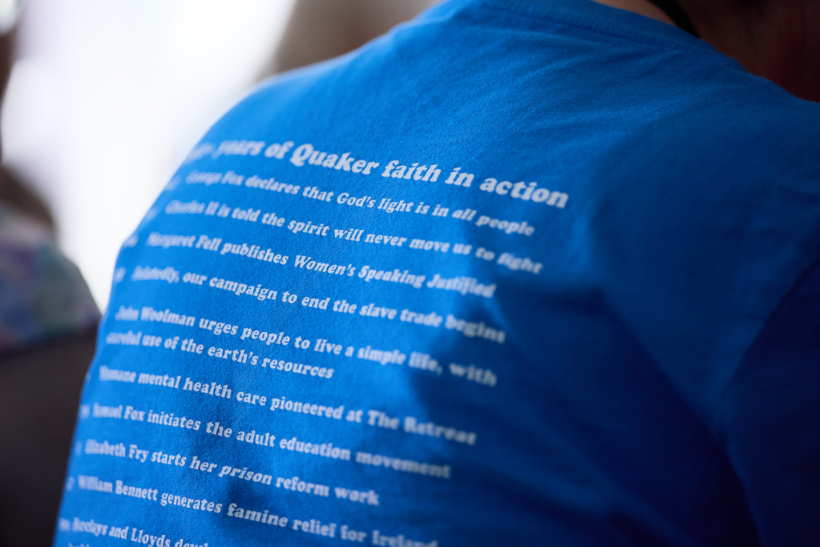
"We have been reminded of the original purpose of Meeting for Sufferings in alleviating the suffering of individuals and their families in facing the consequences of witnessing to their faith and in challenging the legal framework that attempted to shackle them. We are encouraged to engage in faithful witness in whatever form, whether that is direct action, material support, or upholding and prayer.
We are concerned that there is a creeping repression on the part of the state, which potentially undermines the trust on which society is based. We have noted that sanctions are unevenly applied and that we are drifting towards the unacceptable.
We must commit ourselves, both individually and collectively, to resisting the oppressive power of the state where this is necessary. We look to work towards the repeal of the measures restricting protest of which we have heard." – Meeting for Sufferings, March 2025
Friends, it's hard to know where to start with this. We have been talking about this for a long time.
I could start with the women who cut the wire at Greenham Common, or Helen Steven at the Faslane nuclear submarine base in the 1980s.
I could start with our Yearly Meeting's discernment about Trident Ploughshares in the 1990s, deepening our understanding of non-violent direct action.
I could start with the passage of the Terrorism Act 2000, which added serious damage to property to the definition of terrorism – going beyond the international understanding of terrorism as causing fear and a risk of harm to human life – and was criticised both by Quakers and the United Nations at the time.
I could start with the actions of the Stansted 15 – who included a Quaker – to resist the deportation of asylum seekers, whose nonviolent direct action was classed as endangering the safety of an airport, rather than the more minor criminal damage charges they had been expecting.
I could start with the draconian sentences handed down to environmental defenders such as those we heard about in ministry earlier. Sentences which again attracted international concern about how things were changing in the United Kingdom.
Increasing restrictions on protest
I could start with the Police, Crime, Sentencing & Courts Act 2022, which brought in restrictions on gatherings and encampments. Quakers played a significant role in bringing together a coalition of over 250 organisations who worked hard to resist the worst of the government's late amendments to that already draconian law and defeated some of them in the House of Lords. Or the Public Order Act 2023, which brought them all back again – criminalising locking on and blocking roads and other national infrastructure.
Or I could start with the police raid at Westminster Quaker Meeting House in March 2025 and the arrest of young activists who were just talking about actions to protest about government inaction on climate breakdown and the war in Gaza. Whilst policing of this kind was not new – especially for environmental groups and to people of colour – it shocked wide sections of the public that something like this could happen in a place used for worship. Westminster Local Meeting and Quakers in Britain received many outpourings of support, including from synagogues, mosques and many faith leaders from a wide range of Christian and other faith communities. There was a remarkable, and very large, outdoor and online meeting for worship outside New Scotland Yard a few days later – joined by many from outside our Quaker community.
I could start with the proscription of Palestine Action under the Terrorism Act I mentioned earlier, which has led to the arrest and charging under that Act of thousands of people, including dozens of Quakers, for peacefully holding placards in support.
Or I could start with the Crime & Policing Act 2026, which received Royal Assent last Wednesday, and which contains provisions to limit 'cumulative disruption' from protests which happen recurrently in the same location.
Or I could start by talking about the many examples of how the mechanisms we have to hold the powerful to account are being gradually and systematically peeled away – the undermining of international law, the growing disrespect for hard-won global multilateral processes, restrictions in our own country on civil society campaigning, the escalation of punishments, hostile policing, harassment and arrests without charge, and threats to access to jury trials and judicial reviews – a broad trend away from recognising the importance of hearing and valuing dissent, understanding – as I think we do – that hearing diverse voices is one of the important checks and balances on the exercise of power by those who hold it. Meeting for Sufferings asked for work on policing, protest and the state as long ago as 2012, and in 2025 described the situation in this country as "creeping repression", giving us a mandate to resist this trend.
Learning from our Quaker history
Or I could even have started somewhere in the seventeenth century with some of the tensions between our faith community and the state we heard about in Saturday's Swarthmore Lecture. Stuart Masters told us about the time early Friends spent convincing those in power at the time that Quakers were a peaceable people, interested in peace and justice, and as such were not a threat to the secular state but sought to improve it. William Penn said:
True godliness don't turn men out of the world, but enables them to live better in it, and excites their endeavours to mend it… Christians should keep the helm and guide the vessel to its port; not meanly steal out at the stern of the world and leave those that are in it without a pilot to be driven by the fury of evil times upon the rock or sand of ruin. – Quaker faith & practice 23.02
So maybe where we should really start is with that which impels us to protest. The promptings of love and truth in our hearts that lead us to speak truth to power in love.
Advices & queries, number 35, tells us to:
Respect the laws of the state but let your first loyalty be to God's purposes. If you feel impelled by strong conviction to break the law, search your conscience deeply. Ask your meeting for the prayerful support which will give you strength as a right way becomes clear.
And so we should be clear that all Quaker protest and nonviolent direct action have their roots in love. That's why our actions are not just incidentally nonviolent but inherently peace-seeking. And they are tested, individually and collectively in our worship and in our community, to guard against the risk of Friends mishearing what it is that we are prompted to do.
How can it be right for the state to intervene in loving actions which seek to bring about the Kingdom of Heaven in the here and now.
Changing legislation
So, what have we been doing recently?
For many years, Quakers have been convening a growing group of civil society leaders who share our concern for the shrinking of civic space and the loss of accountability. From this grew the coalition of organisations which resisted the worst of the Police, Crime, Sentencing and Courts Act 2022.
We successfully drew media attention to the first raid on Westminster Quaker Meeting House – which has been so difficult for that meeting. With Friends from that meeting, we met the Deputy Mayor of London responsible for policing to talk about her concerns. We also, after much badgering, secured a meeting with the Minister of State for policing to do the same. Both were helpful, cordial meetings.
We sought to intervene in the judicial review of the decision to proscribe Palestine Action – not so much to comment on the decision itself, but to highlight the impact of that decision on us as a faith community. The court denied us permission to intervene, but preparing our witness statement was a helpful exercise and it is in the public domain.
Drawing on very generous financial support from the Joseph Rowntree Charitable Trust following the raid on Westminster, we have worked very hard to try to amend the Crime & Policing Act as it passed through parliament. We co-ordinated a statement from faith leaders including bishops, rabbis and imams criticising the provisions on protest which pass places of worship.
Raising awareness
Although we weren't successful in removing the provisions on cumulative disruption, our Public Affairs staff team briefed many MPs and Peers, ensured that the Bill was debated rather than nodded through, and did a good job of raising public awareness about the problems with this law – along with other supportive organisations who we work closely with. And one of the team spoke at a rally in Parliament Square on the day the Bill became law.
We made a submission and attended two roundtables as part of the government-commissioned Independent Review of Public Order and Hate Crime Legislation – an unhelpful conflation of two largely unrelated issues if ever there was one, and which we pointed out, of course, in our evidence.
We co-convened a meeting for Gina Romero, the United Nations Special Rapporteur on the Rights of Freedom of Peaceful Assembly and of Association, to meet with civil society representatives and another with members of the legislature, on her recent informal visit to the United Kingdom, and were able to share our concerns with her, and hear her concerns about the state of those freedoms in the United Kingdom today.
Providing evidence
And we are in the process of making a submission to the parliamentary Joint Committee on Human Rights inquiry into Safety, Security and Protest: the role of Human Rights. Our standing in civil society, especially at the moment on this issue – the result of that awareness-raising by our Public Affairs team I mentioned just now – led them to invite me to give evidence in an oral hearing of the Committee, alongside the Director of Liberty, a lawyer who represents many nonviolent activists who get into scrapes, and a former chief constable and Chief Inspector of Constabulary.
At that evidence session – which I know many of you, along with a third of a million other people, have seen parts of online – I was able to challenge the assumption that protest is a threat to communities, when protesters are an integral part of the community; to share some of the personal testimony we received from many Friends about the impact the changes to protest legislation are having on their freedom of assembly and of expression (huge thanks to our Friends for those, and to my colleagues in BYM's Faith in Action team for collecting them all up); and to point out the protest is by nature disruptive to some extent, sometimes even really annoying both to the public and to government, and that a right to protest which extends only to polite, non-disruptive activity is not a right worth protecting, and will not lead to the healthy, thriving, often messy, but peaceful democracy we seek.
Prophets and reconcilers
There are some dilemmas in all of this, of course.
How do we define, maintain and ensure our commitment to nonviolence? How do we ensure that our actions do not, accidentally or otherwise, spill over into things which cause real harm to individuals' lives, wellbeing and livelihoods.
How do we ensure we are not claiming a right for ourselves, while rather wishing to deny it to others who make us uncomfortable? Are we willing to give up some of what we want to do, so that society at large can benefit from limiting what they want to do?
How do we balance our desire, often at the same time, to be both prophets and reconcilers, to quote from Wolf Mendl's 1974 Swarthmore Lecture? We spent a good deal of time on that last year when we were considering our long minute on Gaza, where we recognised that we had to speak out in fierce love – both for the people of Gaza and with care for our relationships with Jewish communities and others here at home.
So we return to the need to test that our protest is rooted in love, truth and peace. It is a part of our testimony, our lived expression of our faith. It is not, for the Friends engaged in it, experienced so much as a choice but as a calling. And the implications for many of those who courageously engage in it can mean prison, deportation, loss of job or career, and major issues both with and for their families.
There are echoes in all of this of our Quaker past. I hope we can spend some time upholding all those Friends who take bold action for a peaceful, just and sustainable world.