Dialogue, freedom of speech, and the right to peaceful protest
Why is protest part of dialogue? Highlights from Billy Vaughan's recent talk at the National Justice & Peace Network conference.

What do we think when we think of 'dialogue'? My work takes me into the corridors of Westminster, into parliamentary committee rooms, and alongside grassroots Quaker activists and faith communities. In our political and social landscape today, talk can feel remarkably cheap, but true dialogue has rarely felt more costly, more rare, or more desperately needed.
As the late Pope, Francis, observed: “We dialogue to meet each other, not to fight". Some might think that protest falls more into the 'fight' category than the 'meet'. I disagree strongly. In the Quaker tradition, seeking truth requires us to listen deeply for that of God in everyone, while also finding the spiritual courage to speak truth to power from a place of love.
When people hear the phrase 'freedom of speech', they often picture a podium, a television debate, or a parliamentary chamber. When they hear 'dialogue', they picture two people sitting in a quiet room, drinking tea, exchanging viewpoints.
I want to broaden our definition.
Protest is not the opposite of dialogue. Protest is what happens when official, and some might say 'polite', channels of dialogue have failed, closed their doors, or refused to listen. It is a community saying to the powerful: “We are still here. We have something vital to tell you. Listen to us."
To understand why this is needed, consider how these official channels actually work. When a government launches a public consultation or invites stakeholder feedback, who gets heard? It is often the well-resourced interests, the established PR firms, and those who already have direct access to ministers. The marginalised, the powerless, and those whose lives are directly impacted by policy are rarely given a voice.
Public protest is the democratisation of dialogue. It is how ordinary citizens, without lobbying budgets or media control, refuse to be rendered invisible. It is how a community transforms a private grievance into a public, inescapable moral question.
The legal landscape
Why is this so urgent in 2026? Three legislative changes have systematically eroded space for public dissent:
- The Police, Crime, Sentencing and Courts Act 2022 introduced severe restrictions on public gatherings based on noise and disruption.
- The Public Order Act 2023 criminalised long-standing nonviolent tactics like "locking on" and lowered the threshold for police intervention.
- The Crime and Policing Act 2026 introduced provisions to limit "cumulative disruption", granting authorities powers to restrict recurring peaceful demonstrations in the same area.
These laws were passed by both Conservative and Labour governments. Unfortunately, there is a political consensus on restrictions on protest.
This is supported by a false dichotomy pitting 'free speech' against 'protest'. Free speech is painted as intellectual and polite, while protest is framed as disruptive noise.
I reject this division. Protest is speech. It is the ultimate embodiment of free speech. Without protest, 'freedom of speech' becomes an empty gesture and a privilege reserved only for those who already hold the microphone.
Protest as dialogue
Recently, our Recording Clerk Paul Parker said to Parliament's Joint Committee on Human Rights: "It is an imperative of Quaker faith that we listen in our silent meetings for worship for the will of God, and seek to follow it in our words and actions. That has meant that, since the 17th century, Quakers have been led by faith to bear witness and take action against unjust laws and practices. It is rooted in love and compassion. What we think we are seeing at the moment is the state seeking to interfere in individuals' ability to follow the promptings of love in their hearts as part of their faith."
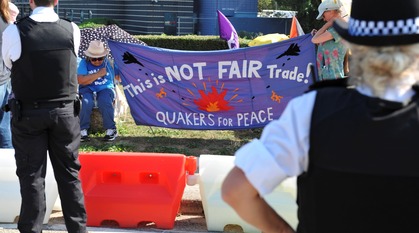
Paul was also able to share testimony from many Quakers: ordinary people such as teachers, healthcare workers, students, and elderly pensioners, who face criminalisation or intimidation simply for standing in public and holding a placard. Many more have stayed away from public protests altogether, for fear of losing professional licences needed for their livelihood; others had caring responsibilities and were worried about what would happen to their loved ones if they went to prison.
These are people who have been prevented from living out their faith, which calls them to show the promptings of love in their hearts. Reading these testimonies made me extremely sad, and extremely angry. One silver lining is that we were able to bring them directly to the lawmakers who were and are responsible. The stories show that current laws are eroding trust in a rights-based civil society and directly affecting people's right to practice their faith publicly.
Genuine dialogue
If we want to build a culture of genuine dialogue, we must defend the right of people to speak in ways that challenge the status quo.
Quakers do not defend protest because we agree with every single tactic or slogan. We defend protest because a society that criminalises nonviolent dissent is a society that has given up on dialogue altogether.
When we stand peacefully in the street, when we hold a candle in vigil, or when we raise our voices for justice, we are not breaking the dialogue. We are bringing it to those who need to hear it most.Watch the talks from the National Justice and Peace Network conference