Organising actions
Once you have decided on the focus of your group's concern and considered the type of change you wish to bring about, the next step is to develop an action that fits with your project. These guides outline some possibilities.
Planning effective action for change
This guide provides an overview of the steps involved in planning action for change, sharing learning and experience from Quakers involved in campaigns on fossil fuel divestment and the Living Wage. It explores how we can move from the prompting to act to an effective plan for achieving change. It outlines steps and questions to help you and your group consider how you might: explore your concern; identify the change you seek and how to create it; develop a project or campaign plan; increase your impact sustain energy and reflect as the project develops.
Download Planning effective action for change (PDF)
Organising actions
Actions are things people do to raise awareness and express feelings about something they want to change. They are a way of sending a public message, attracting allies and supporters, and strengthening a group or movement. They are a way of challenging or encouraging those in power to make a necessary change. Actions are what people do to generate their own power. From a Quaker perspective, actions are an outward collective expression of inner promptings. This guide outlines key steps to consider when organising actions as part of a campaign or project for change. It also explores how we can increase the impact of our actions by working collaboratively, being creative, and sharing our stories.
Download Organising actions (PDF)
Organising a vigil
A silent vigil has a special power. It's simple to organise and anyone can be part of it, whether it is for silent prayer, meditation, mindful presence, or a simple space for reflection and solidarity. Quakers often think of it as a meeting for worship for witness, a public witness to an alternative world of justice and peace. As with a meeting for worship, its power is experienced by those taking part, but with the added dimension of carrying the power of stillness, silence, and dignity to passers-by and watchers. This guide explores different aspects to consider if you are planning to hold a public vigil, or a meeting for worship to witness.
Download Organising a vigil (PDF)
Difficult conversations
There will naturally be a diversity of views present in any given group, and it is not easy when conflicts emerge. These guides offer tips on finding agreement, and managing the group dynamics that influence us all.
Having difficult conversations
As Quakers, the views and opinions we may hold often run counter to the mainstream. Whether we are talking about nuclear weapons, climate change, refugees, inequality or some other controversial topic, it can sometimes be difficult to have a conversation that feels positive and productive rather than the opposite. This tookit provides some tips for how to make those conversations as productive and constructive as possible.
Download Having difficult conversations (PDF)
Owning power and privilege
The concept of privilege – and the power that comes with it – has become a hot topic in recent years. It describes something important, making it a sensitive subject that requires care. Discussions of power and privilege often touch upon inequalities that divide us, at a personal as well as a social level. This includes differences in class, income, education, race and ethnic identity, gender, sexuality, age, the spectrum of disability, and personal wellbeing. This is a resource for starting a conversation, offered as a means of examining systems of privilege that shape our world.
Download
Owning power and privilege (PDF)
Engaging with conflict, challenging hate
This toolkit offers examples and reflection prompts on how to grapple with and respond to conflict and hate, including the two hands of nonviolence (Barbara Deming). The toolkit shares case studies and tips from peacebuilding and conflict practitioners, alongside examples from community activists and organisers who have sought to resist those that seek to divide and dehumanise others.
Download Engaging with conflict, challenging hate (PDF)
Media and social media
Once you've planned a campaign, project or action, you'll probably want to publicise it to gather support, raise awareness of the issue and to reach, or build pressure upon, any decision makers you've identified. These guides offer some ideas about how you can do this.
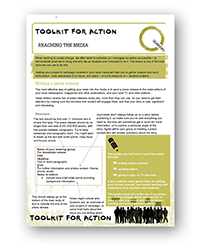
Reaching the media
When working to create change, we often want to publicise our messages as widely as possible – to demonstrate what we're doing and why we as Quakers are motivated to do it. The media is one of the best tools we can use to do this. Getting your project or campaign covered in your local media will help you to gather support and build enthusiasm, raise awareness of an issue, and reach – or build pressure on – decision-makers.
Download Reaching the media (PDF)
Using social media
From a campaigning point of view, although there are risks that come with using social media, it is counterproductive not to use these tools. This is especially true if media outlets are not yet covering the issue you hope to highlight. This guide gives you a grounding in how to use freely available online communication networks. This should make it easier to spread your messages beyond your own immediate social circles.
Download Using social media (PDF)