
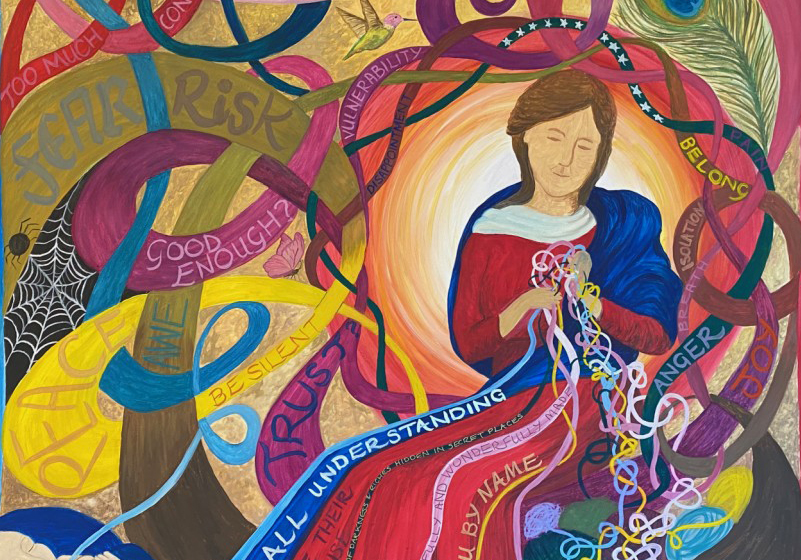
Trustees—our untiers of knots
Across Britain, neighbouring area meetings are forging deeper relationships with one another as they explore the possibilities of restructuring and sharing their governance.
Pioneering the way have been the four area meetings in Wales and Southern Marches, along with Crynwyr Cymru – Quakers in Wales (CCQW), who have joined together to create a single CIO, a Charitable Incorporated Organisation (find out more about CIOs here).
"Instead of five trustee bodies, we now have just one," explained Helen Oldridge, the Local Development Worker for Wales and Southern Marches. "This has required Friends to build a new governance structure and re-imagine how we work together."
Last year, Helen was asked by the trustees of Cymar to create a programme (shared below) for a two-day gather to help them build community and develop learning around the challenges and expectations of the trustee role.
"We took inspiration from the Britain Yearly Meeting's 2013 Minute 20," said Helen, "when Friends had been reminded that our 'spiritual journey is about living in the world and wrestling with the tensions between living out the testimonies and dealing with practical, financial and property matters."
The Minute goes on to state; 'The real test of our faith is whether we can connect with the spirit in the mess of our daily lives.
'Having bodies of named trustees is therefore not about giving all the power to a small group but making sure that all the difficult work gets done. Nor should we be surprised if mistakes are made, as this is where we as individuals fail as well.
'Both trustees and meetings need to hold each other in the light and above all to keep the lines of communication live and vibrant. We all belong to the same worshipping community, we are all working together and it is the same spirit that leads us. Community is two-way. Trustees need to empower other Friends to ask questions, perhaps by making minutes more readily available, and other Friends need to talk to trustees and ask for information. This openness will in turn support trustees in their work."
As Helen was working with the trustees designing the 'Trust in Trusteeship' programme, the clerk, Erica Thomas, shared how she kept being drawn to the Marian concept of 'Mary, the untier of knots,' – the patient problem solver. Erica offered this reflection as an evening epilogue and the group found it a helpful way to consider trustees as untiers of knots.
"It's very easy to forget the spiritual when trustees are dealing with knotty, practical issues to do with money and premises and future planning," Erica explained. "We wanted to remind ourselves that the light is as important in the practical as it is in the pastoral."
Development worker Helen has created a padlet – a digital noticeboard, where she's uploaded her session plans and resources on building trusting relationships between trustees. You can access the padlet here if you'd like to consider rolling it out in your own communities.
The sessions include insightful exercises from Brené Brown that help us to discover the values that really matter to us, as well as how our nervous systems react when we feel overwhelmed or challenged.
"Understanding our nervous system better was a step towards a longer-term initiative to improve communications between trustees and local Friends," said Helen. "Exploring our values enabled the trustees to create a shared vision, grounded in a stronger sense of purpose."
The group recorded their mission as being 'responsible stewardship - for Friends, by Friends, with Friends and underpinned by our shared values of integrity and inclusion and guided by the Spirit.'
"This valuable time together led to the growth of new friendships between Quakers from a wide geographical area who did not all know each other before their appointments," explained Helen. "As a result of the sessions, Friends spoke of feeling more confident about the work required of them, along with increased enthusiasm and a mutual sense of support."
Helen will be continuing to support the development of this work throughout 2026. If you'd like to use the programme with your own trustees you can access the Padlet (offsite link). For more information or support, get in touch with your Local Development Worker.